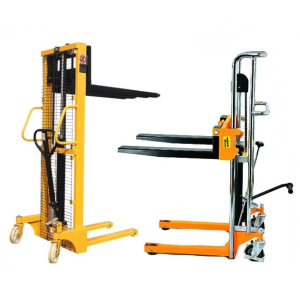
The difference between a pallet jack and a pallet stacker may appear rather obvious – one can lift loads whereas another cannot. But choosing the right type of stacker for your specific operation is where things can get a bit trickier.
Based on our experience, companies tend to purchase a stacker either because of its lower price or easy availability. This approach often leads to problems – such a machine may not cope with the required tasks or become overqualified, which essentially means wasting money.
Understanding the nature of your cargo
load, and its specification is the primary step in choosing a pallet stacker.
A stacker is a device that sits between a
pallet truck and a forklift in terms of capabilities. While being cheaper than
a forklift, a stacker is intended to transport heavy and bulky loads to higher
heights than possible using a pallet truck.
As far as our experience shows, people usually underestimate the required lift height until it measures the racking. Therefore, you should define the lift height prior to selecting a stacker.
This is the most frequent question that we
receive and the answer depends largely on the number of loadings and cargo
weight.
A manual winch is a traditional mechanism
that allows lifting the forks by hand. It is less expensive, but in cases of
heavy loadings and regular work during a day, it becomes tiring for the
operator.
A stacker that is operated hydraulically
raises the forks using a lever or a pedal. In our experience, this solution
works better when the loads are heavy or there is a necessity to use the
stacker daily. The pumping process is easier than winding.
If the work is performed continuously, it is reasonable to invest in a hydraulic stacker from the very beginning.
Many people underestimate the importance of
this factor, and it catches them out.
A fixed leg stacker is less complex and
smaller in size, but it requires the usage of euro-style pallets with holes in
the bottom. For the work with solid-base pallets and other kinds of pallets, a
fixed leg stacker cannot be applied.
A stacker with straddle outrigger legs can be adjusted and it straddles the pallet from the sides. Such a stacker is more flexible as far as the variety of pallets is concerned.
A stacker needs manual operation and
steering, therefore the condition of the floor is important. A smooth and flat
surface is preferable; otherwise, the operation will be complicated and
unstable.
Also, the width of aisles plays an
important role. According to our experience, many businesses do not pay enough
attention to this parameter before buying the equipment.
You should measure the narrowest aisle and check whether it is wide enough to maneuver a stacker.
Although warehouses and distribution
centers seem to be the only places where stackers can be applied, this
equipment is used in manufacturing facilities, loading areas of vehicles,
retail stockrooms, and agricultural stores.
When the stacker is supposed to perform the loading of vehicles, the height of the platform and the length of the forks should be taken into account as the requirements for these parameters in case of stacking the racks in a warehouse may differ from the ones related to loading the trucks or vans.
This point may sound too simple, but it is
necessary to consider the person who is going to use the machine daily.
Manual stackers need physical efforts –
especially when the loads are close to the maximum lifting weight. Based on our
experience, the company with the variety of operators of different fitness may
find a hydraulic stacker more convenient.
The training of operators is easy for most of the stacker types; however, they should know the rated capacity, the correct positioning of the loads, and safe operation on slopes.
Pallet stackers are rather maintenance-free
machines in comparison with the powered handling equipment, but it does not
mean that they do not require any servicing.
The hydraulic system should be checked from
time to time for the fluid levels and leaks. Wheels and castors wear gradually,
especially on rough floors. Forks and mast should be inspected regularly for
damages and wear.
In our opinion, the companies that service their stackers regularly get the most of their longevity.
Selection of the proper stacker depends on
understanding your load weights, lift heights, pallets, floor conditions, and
frequency of use.
If you manage to get the basics right, you
will have a reliable stacker that will serve you for many years. Otherwise, you
will face difficulties or be forced to change the equipment earlier than it is
supposed.
If you are not sure in the type of the
stacker that you need, our team is ready to help you with it. Our company has
supplied material handling equipment for 30 years and we can give good advice
at the beginning saving you a lot of troubles in the future.
To learn more about pallet stackers and to
get recommendations on your specific requirements, you can contact us by phone
01384 76961.