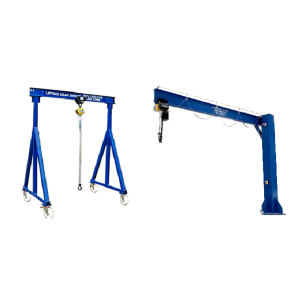
This case study examines how we helped a customer based in the Dudley area choose the best lifting solution for their machine shop where they needed to lift loads in different areas. Here is the low down on our thought processes, customer discussions and factory visit to arrive at the best solution to suit the customers needs.
The medium sized machine shop required a cost effective lifting solution to help with load handling in different areas of the factory. Fabricated steel components weighing between 500kg and 3000kg are regularly handled in three key areas; a CNC machining area, a welding station and a staging area which are spaced some distance apart. With no overhead crane infrastructure and low ceiling height the company was struggling with its load handling.
After a site visit with some basic measurements taken (distance between stations); we discussed in depth what, where and how the loads needed to be lifted and moved. It was determined that generally the loads needed handling within their specific work areas with other options in place to transfer loads between each area if required.
Our immediate thoughts were either a lifting gantry or a swing jib crane. With Jibs being able to move loads between set areas but are fixed, or a mobile gantry that can be moved from place to place although shouldn't be moved whilst loaded. So we discussed some pros and cons for each.
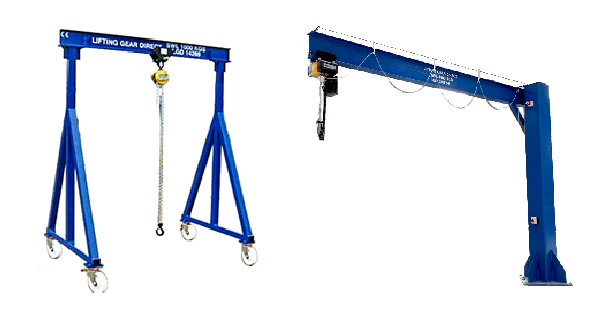
Here we assess the pros and cons for lifting gantries and swing jib cranes to put to the customer to help determine their most suitable option.
Option 1: Lifting Gantry
Lifting Gantry Pros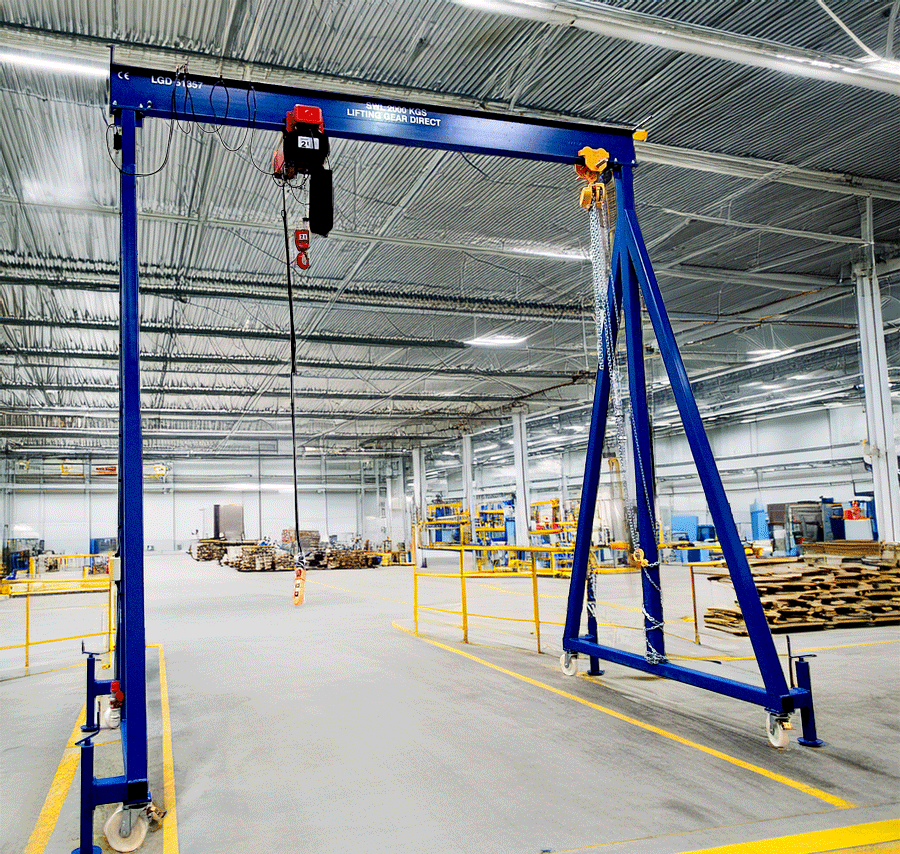
Location Flexibility; A gantry is not fixed in one place and incorporates heavy duty castors so it can be moved around at will. Thus it could easily serve each area as and when loads need lifting.
No Structural Modification; Because the gantry is free standing, no structural alterations are required, when compared to a jib which may need additional structural groundworks.
Capacity and size; The maximum lifting capacity possible is 5000kg. The beam span / load moving area goes up to 5 metres as does the maximum height of lift under the beam; Thus more options than a swing Jib.
Coverage area; The footprint will differ depending on the size, specifically the beam length/span. They are easy to position directly above most loads, the longer the top beam the more coverage area you have to work with. For example if the span is 4 metres it can be positioned to pick the load up at one end so you will have roughly 4 metres (minus the hoist dimension) to move the load.
Storage and transportation; Our custom lifting gantries come in three parts – 2 x A frame side legs and the top lifting beam. The parts are simply bolted together, thus can be disassembled for storage or transportation if required.
Permissions; No structural inspections or building owner permissions are required.
Gantry Cons
Floor Space; The floor space taken up by a gantry is determined by the size of the side A frames and castor wheelbase. Although they will always take up some floor space it is often possible to slide the legs between other objects to minimise the amount taken up.
Manual Positioning Effort; Although the gantry is pretty easy to move around thanks to its castors, obviously some degree of physical effort will be required. Floor space within the moving zone will need to be cleared.
Weight, size and Capacity trade off; The larger the working load limit and physical size of the gantry the larger and bulkier the framework will be due to larger steel sections, thus it will also be heavier to move around.
Option 2: Swing Jib Crane
Jib Crane Pros
Wider Load Moving Scope; A jib can be used to move loads across the beam just like a gantry, however the load can also be rotated along with the jib arm through its degree of rotation (typically 270 degrees). Therefore a load can be picked up from one workstation, moved over the beam, and rotated to a different area within its arc to be set down.
Faster load moving; Moving loads from area to area can be completed quite quickly thanks to the rotating arm.
Precise Load Positioning; Due to the dual movement options giving a wider scope, beam travel and arm/boom rotation loads can be positioned more precisely.
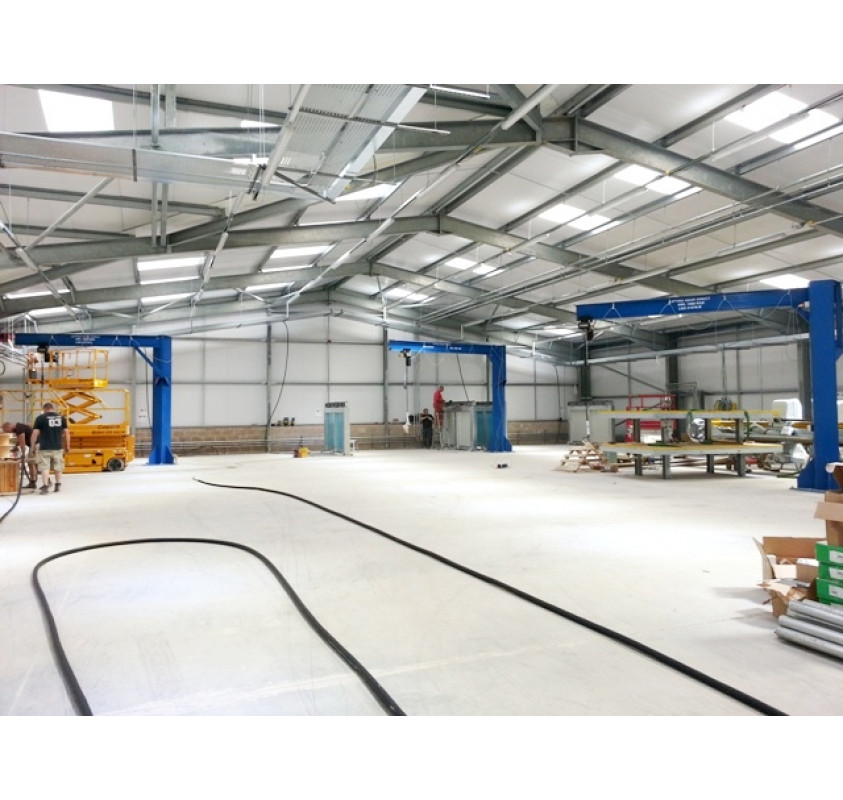
Jib Crane Cons
Permanent Footprint; these cranes are permanently fitted to the floor, taking up valuable space, the size will be determined by the size of the swing jib you need; the larger the WLL the larger the steelwork and base footprint will be.
Structural Requirements; Because a jib is anchored into the ground certain criteria must be met and may need the expert assessment of a structural engineer prior to installation.
Professional Installation; A jib crane must be installed by professionals who will use special chemically anchored bolts to secure. Once the crane is installed it will need to undergo load testing to ensure correct operation and most importantly ensure is is solid and safe to use.
Permanence; Once installed these cranes require a significant undertaking to be removed. So if the workplace layout changes from time to time a fixed crane could cause major issues such as not being able to handle loads in the right area or create a obstacle where you want to move equipment to a new location.
Permissions required; Not only might you need a structural engineers permission you may also require approval from the building owner as it will be a fixed structure.
Size Limitations; Our maximum Jib capacity is 3 tonne and a radius/arm reach of a maximum 4 metres. Heights also have a maximum limit of 4 metres. Somewhat lower than a gantry.
After discussions on how the factory normally operated and where lifting zones were essential, whilst bearing in mind potential layout changes in the future the customer decided on a lifting gantry, although it was a close call.
It was decided that a mobile lifting gantry would provide more flexibility without hindrance to layout changes. Also the older style building posed questions as to the structural integrity of the floor which could cause potential problems and additional costs. The maximum reach of the jib option was not quite enough either.
Another deciding factor was that should a load need to be moved between areas then their current or other system would work (forklift, scissor lift table or pallet truck).
The final decision ultimately came down to the size and working load limits available in a custom crane. Due to their top loads being around 3 tonne and the top WLL of a Jib crane also being 3 tonne it was decided it was too close, just in case something heavier came up in the future.
It was also decided that if they had the maximum span of 5 metres (with a 4.5 metre height of lift to fit into the roof space they had) it could be positioned over each area with room to move and lower the load out from the work area to another means of load moving such as machine skates, fork lift or pallet truck depending on the size and weight of the load.
Working side by side with our customer the right balance of lifting capability, manoeuvrability, versatility, space and cost was achieved. A gantry was ordered with a 5000kg WLL, a 5 metre span and 4.5 metre lifting height. In addition parking jacks were added to enable better stability on some or their uneven floors. A Delta manual chain hoist and trolley was also added to the gantry, which was a most suitable and cost effective method at this point, with the option to have a powered trolley and electric hoist in the future if required.
The complete set up was manufactured, delivered and even set up as requested within 14 days. Full certification was issued for customer records, safe in the knowledge that we would be in touch in 12 months time for its required annual thorough inspection to comply with LOLER regulations.