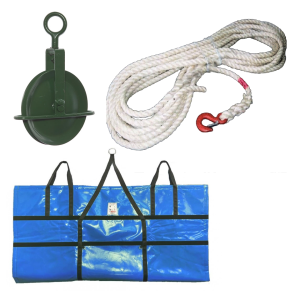
A few months ago a mid sized, midlands based construction business contacted us to discuss their issue with lifting solar panels during installation; this is becoming an increasingly common question we get asked for solar projects on both residential and commercial buildings. Find out the methodology in finding a simple solution for the customer in this case study.
The business in question had recently taken on a number of domestic solar installations with a wider fitting contract not too far away and were struggling with their current handling process.
Manually handling solar panels is difficult not only because of their size and weight but because of their rather delicate nature. Workers were apparently manually carrying the panels up ladders etc. and in a short space of time one worker twisted his back out due to the awkwardness of handling the panels whilst ascending a ladder and one panel was damaged with a wind gust causing it to make contact with a hard object during lifting and cracking a cell – a costly mishap!
What is the safest, quickest and most cost efficient way to lift a solar panel to a rooftop without the need for larger industrial equipment?
The client knew that an electric scaffold hoist or a mobile crane would do the trick, however the outlay would be sizeable and not feasible at this time. Thus looking for an affordable alternative.
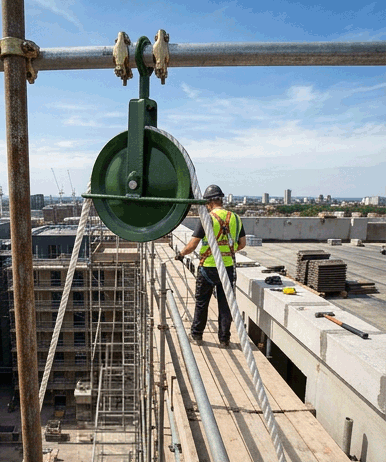
Sometimes it pays to go back to basics so we suggested a simply rope and pulley type system. A Gin wheel is a great piece of equipment in the lifting world, simple but effective! A gin wheel is a grooved wheel within a frame that incorporates an eye which fits onto most scaffold poles with ease. (scaffold towers should be available on all rooftop work). Strong pulley rope which is typically a fibre rope which is hand spliced with a safety load hook fitted to one end is used. The rope passes over the wheel groove/recess; the hook end attaches to the load, the free end is hand pulled to lift the load.
Customer reaction
This could really work, but! How can we safely anchor the solar panel and protect it during lifting?
With one additional piece of equipment and a small outlay all problems could be solved.
By adding a solar panel lifting bag into the equation lifting will be straight forward and guided whilst the panel will be well protected.
These lifting bags are specifically manufactured for handling solar panels, although they can also be used for a range of other similar shaped items such as radiators or perhaps glass or wood panels.
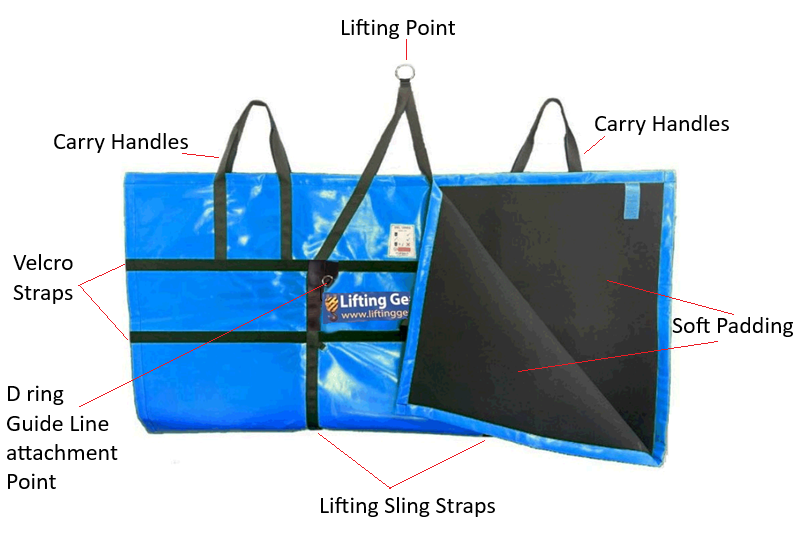
Made from a single piece of padded polyethylene type material with open sides and top the panels are easy to position within the bag. The sides and top are then secures with very heavy duty velcro straps to ensure the panel stays put. There are two carrying handles on each side to help with handling before and after the lifting process. In the mid section of the bag there is a stitched in lifting sling which passes right under the bag and incorporates 2 rings at the top to attach to a pulley load hook. This ensures the load is well supported and balanced when the panel is positioned centrally.
During the lifting process unwanted movement can sometimes occur often due to windy conditions, to counteract this issue there are some 'D' rings on each side of the bag where guy lines can be attached to enable a person on the ground to control the lift. Using this method also enables the guide lines to be used to pull the panel bag out and away from protruding objects.
The customer decided to give this system a go due to a few different factors;
1: Cost; The complete set up with a gin wheel, pulley rope and panel lifting bag came in at a fraction of the cost that a scaffold hoist or crane would, whether to buy or hire.
2: Versatility; The lifting bags can be used for other items as well as solar panels which the customer saw as an added bonus. The simplicity means little after care costs whilst taking up little room during storage and transportation; they components are light and easy to handle.
3: Speed of Set Up:; In just a few minutes the gin wheel can be attached to a scaffold or other suitable anchor point and the rope fitted ready to accept a loaded lifting bag.
4: Risk Reduction; Because the solar panel lifting is carried out from ground level the risks from working at height are eliminated for the handler. Using guide lines, loss of control is minimal, thus reducing the risk of panel damage.
The only potential downside is that physical man power is required to pull the rope and loaded bag, although the gin wheel system does alleviate some of the effort required. Moving forwards it would be possible to use a small winch to further reduce physical stress.
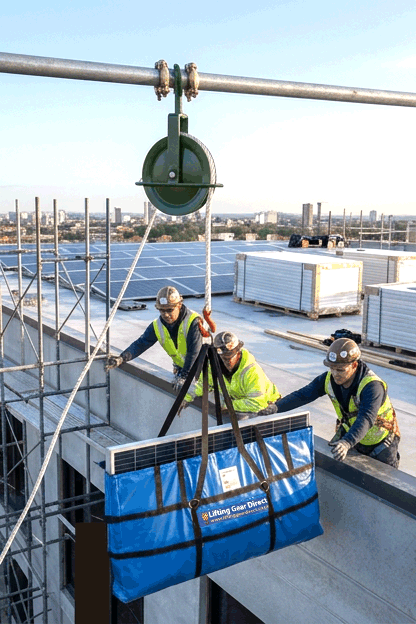
Since adopting the gin wheel, rope and lifting bag system our customer reported much faster panel handling with no more damage or near misses. Physical strain had also much reduced as the team no longer had to man-handle the panels to the roof top.
Importantly the set up sits well within the company's risk assessments for lifting and working at heights, thus it would be easy to roll out for each team on all construction sites without specialist training or plant certification.
One happy customer!
This case study just goes to show that big, expensive, powered equipment isn't always necessary or proportionate to the task. This simplified handling solution really does go back to basic lifting task implementation with the gin wheel pulley system but with the modern method of handling the solar panel with the purpose made lifting bag.
Using this practical set up keeps your panels and workers safer, handling is quicker and easier and the outlay is relatively small.