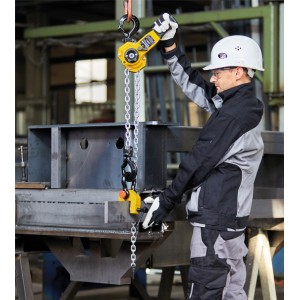
Having supplied lifting gear for over 25 years to businesses in the UK, what is most likely to be overlooked during any project becomes quite apparent – as is the pre-use checks of equipment.
Of course, it is very difficult to expect from workers to perform such checks when the working schedule is very tight and the equipment seemed to be okay yesterday. Yet, in our experience, this is where problems start.
A pre-use of components check takes
minutes. The results of not performing one could be far more serious.
It is essential firstly to make a clarification on this matter; as there seems to be a great deal of misunderstanding regarding the definition of a pre-use check among workers in the field.
The pre-use check, routine inspection, and LOLER thorough examination are three different terms and none of them mean the same. The pre-use check is the operator's quick check of whether the equipment is safe to be used. The routine inspection is a recorded inspection done by a competent person at set intervals. The LOLER thorough examination is the statutory requirement performed at set legal intervals.
All three are important, yet the first one is the one that should be done by your team each time before a lift is made.
According to HSE PUWER Regulation 4, an
appropriate operator pre-use check of work equipment is implied. This check
cannot be optional.
Depending on the equipment, it is crucial to look out for particular features of the lifting device. The following is what should be examined:
Chains and chain slings – check for any wear, elongation, and distortion. Once a chain is stretched beyond its tolerance it means that the chain has been overloaded and should be retired. Any cracks, nicks, or gouges in the links are to be considered as signs of wear. If the link appears to be different from others it requires careful inspection. A galvanised chain may appear to be corroded, but in case of the visible corrosion of the underlying metal, it is high time to retire this chain.
Webbing and synthetic slings – in our experience, the webbing slings usually take more damage than people realise and are retired too late. Look for cuts, abrasions, fraying, and any signs of heat or chemical damage. In case the discolouration is noticed it is a sign of chemical exposure. Webbing slings with any visible damages of load-bearing fibres should not be used. The capacity markings on labels should be readable.
Wire rope – look out for broken wires, kinking, crushing, or corrosion. Broken wires visible on the section of the rope indicate that it requires more detailed inspection by a competent person. Kinks on the wire are extremely dangerous as the rope has been already damaged and will never have the same strength again.
Shackles – the pin should be properly inserted, and the nut should be tightly fitted. The bow of the shackle should not have any bends, cracks, or distortions. A shackle that has been overloaded usually has a slight deformation which could be unnoticed unless it is being carefully examined. Safety factor on the shackles is typically 5:1 or 6:1, yet the safety margin implies that the shackle is in perfect condition.
Hooks – the safety latch should be present and function properly. Any twist, bend, or opening of the hook's throat means that the hook had been stressed and should be retired from service right away. Hooks in our experience are the most frequently compromised component.
Hoists and chain blocks – brake should hold properly before the lift takes place. If there is any doubt about the correct operation of the brake, it should be operated unloaded. Oil leaks, damaged chains, and any strange sounds while hoisting should be considered as signs of malfunction.
Lever hoists – pawl and ratchet mechanism should engage properly. The load chain should be inspected for any wear and run freely through the mechanism. Free-chain facility should function properly; otherwise, there is a problem.
Eye bolts and lifting points – eye bolts in our experience are one of those components that can
be easily overlooked as they look simple. Undamaged thread and full seating of
the eye bolt are to be inspected. Eye bolt not seated fully will fail under
much lower load than its rated capacity. Any bends or distortions of the eye
itself are to be examined.
Apart from the obvious visible damages, there are several less noticeable factors that are sometimes missed by operators in their pre-use checks due to the lack of training.
There may not be any obvious signs of overloading. A sling or chain that had been overloaded once can seem to be in perfect condition, but its structure could be compromised. One of the reasons why it is important to keep all the relevant documentation is the following – if any equipment has been involved in any incident or near-miss situation it should be inspected and retired despite its appearance.
Improper storage affects the lifespan of the equipment faster than one would think. In our experience, lifting equipment that has been stored improperly – left on the floor of the yard, exposed to the weather conditions, or hung wrongly – has shorter life span than equipment stored properly. The location of equipment since the last use should be taken into account while performing pre-use checks.
Assembling equipment from different sets
creates compatibility risk. Shackles from one set together with the sling from
another set may look fine but have different capacities. It is always important
to check the complete set of equipment to be sure that all components have the
same rating.
One of the common myths is that if there is a recent LOLER thorough examination then pre-use checks can be performed less carefully. Unfortunately, it is not the case.
The failure of equipment is rarely a surprise. It is often the result of deterioration, misuse, damage, poor storage, or inappropriate modifications that have not been detected on time. LOLER thorough examination indicates the condition of the equipment at a certain point in time. Damage can happen the day after examination as well as the day before the next examination.
Both pre-use checks and LOLER thorough
examinations are necessary, and neither can replace the other.
Pre-use check is useless unless the defect is reported and the equipment is taken out of the service. In our experience, the problem with many operations is not the check itself but the process that takes place after the check is done.
Operators should be aware of what to do in case of any defect. Equipment should be withdrawn from the service immediately, labelled properly so it would not be accidentally used again, and reported to the person responsible for the equipment maintenance and replacement. The next person who will be using it should know whether it has been already checked or not.
Creating simple records of pre-use
checks even informally is helpful. This way it is possible to identify whether
the equipment is used properly.
It is not instinctive to know what signs of the damage look like. In our experience, the failures of pre-use checks often depend on the fact that the workers have not been shown what signs of damage of particular equipment to look out for.
The demonstration of the equipment in
worn and serviceable condition to new employees is more effective than any
written checklist. The difference between lifting slings in good condition and the ones that need to be retired is not always huge – but it is visible to the trained
eye.
Pre-use checks are the most effective and consistent safety measure that any operation with lifting equipment can use. It does not require special knowledge or much time, but is much more likely to detect developing problems than any other activity related to inspections as it takes place every day.
In our experience, the operations that manage safety well are not the operations with the most sophisticated systems. They are the operations in which pre-use checks are performed regularly, defects are addressed quickly, and nobody lifts loads using equipment he or she is not confident in.
If you have doubts whether your team is able to perform pre-use checks properly or need some help with deciding the condition of your current equipment before the retirement, we are ready to assist. We have been doing this for so long that we have seen almost everything.
If you want some advice on the condition
of your equipment, replacement or pre-use inspection instructions, call us on
01384 76961.