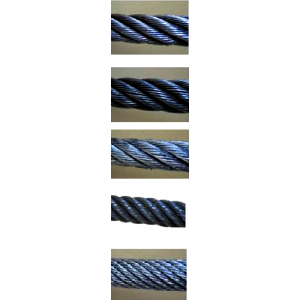
We are often asked about the difference
between stainless steel wire rope and galvanised steel wire rope, and which one
is best for a particular application. It’s a reasonable question, as both
products appear very similar at first glance and, indeed, are designed for the
same general purpose. That being said, getting the wrong wire rope for a
particular task can prove to be a costly error.
Galvanised wire rope, quite simply, is
steel wire rope that’s been galvanised, which basically means that it’s been
coated in a layer of zinc. This provides a reasonable level of protection
against corrosion in most conditions. It’s been the standard wire rope for
general lifting and rigging work for many decades, and it’s hard to argue with
that, as it works well and doesn’t break the bank.
Stainless steel wire rope, by contrast, is
made from a steel alloy that’s been mixed with chromium, and often nickel,
which then provides a protective oxide coating that’s extremely resistant to
corrosion. This isn’t a coating that wears off; it’s a permanent feature of the
wire rope itself.
We stock both types in our warehouse, and
in the 25 years that we’ve been in business, we’ve seen people make bad
decisions with regard to wire rope in both directions – overspending on
stainless steel wire rope when galvanised steel wire rope would have been
perfectly acceptable, and vice versa, trying to cut costs with galvanised steel
wire rope in an application where it simply won’t last.
For most standard lifting and rigging
applications in a relatively dry environment, galvanised wire rope is perfectly
acceptable, and we sell tonnes of it to construction sites, factories, and
workshops throughout the UK.
A customer of ours is a machinery moving
business based in the Midlands. They use galvanised wire rope to load equipment
onto lorries, place machinery in factories, and generally do rigging work. They
get many years of life out of it because the wire rope is not subject to wet
conditions most of the time.
Indoor applications are where galvanised
wire rope is best used. If you are going to be using your wire rope inside, and
it is only going to be subject to wet conditions every now and then, then
galvanised is the way to go. You can save a lot of money versus stainless
steel, especially when dealing with larger diameter wire rope or longer
lengths.
The coating will wear off eventually, and
this is actually a good thing because you can tell when the wire rope is
getting close to the end of its lifespan because the steel underneath the
coating will start to show through.
The first time you should think of using
stainless steel wire rope is when you are going to be near the sea, and the
salt water is going to be subject to the wire rope. The zinc coating will wear
off quickly, and the steel underneath will start to rust and corrode. We sell a
lot of stainless-steel wire rope to marine environments, such as to boat owners
and marinas.
We have a customer who has a fleet of
fishing boats based out of Hull. They tried using galvanised wire rope at first
to save money, but they found that they had to change it every season because
it corroded so quickly. They switched to 316 grade stainless steel, and the
wire rope lasts them years, even in the salty water conditions.
Food processing plants require a wire rope
made from stainless steel due to hygiene reasons. It must be able to withstand
regular washing with cleaning agents and hot water. Galvanised just will not
work; the zinc coating will degrade very quickly.
Chemical plants are yet another example of
where stainless steel can be used. We have sold wire rope to pharmaceutical
companies, water treatment plants, and other industrial sites where the wire
rope is exposed to corrosive substances. Galvanised would not last a month in
some of these places.
Locations near the coast are borderline
cases. Unless your wire rope is going to be regularly dunked in the sea, salt
spray can be quite corrosive. We recommend stainless steel for any permanent
installation within a few miles of the coast.
In terms of specification, when buying
stainless steel wire rope, there are two types: 304 and 316. For most locations
within the UK, we recommend 316, although this is more expensive than 304.
316, or marine grade, wire rope contains
molybdenum, which provides superior corrosion resistance to chlorides. If you
are near the sea or are exposed to road salt in winter, this is an advantage.
We have both types in stock, with 316 making up 80% of our sales of
stainless-steel wire rope. Whilst the difference in cost between 304 and 316 is
not huge, the superior corrosion resistance of 316 is an advantage for many
locations within the UK.
In these types of application, stainless
steel wire rope can be said to have an advantage over both galvanised and
stainless-steel wire ropes, simply by looking at their appearance.
We supplied a hotel refurbishment project
in Manchester with stainless steel rope last year. The architect requested it
for cable railings in the atrium area. While galvanised would have been strong
enough for the structure, it would have looked awful within a year or two as
the zinc coating wears off.
There is no getting around it - stainless
steel wire rope is a lot more expensive than galvanised. You may find yourself
paying two or even three times as much for the same product.
You should also consider the cost of
maintenance and replacement over time, though. If the galvanised rope lasts two
years, and the stainless-steel rope lasts ten years, then it is a lot more
cost-effective in the end.
If it is a one-off or a temporary
application, then galvanised is probably more cost-effective.
Stainless steel wire rope is also slightly
stronger than its galvanised equivalent.
While this may not seem a lot - perhaps
only 10 or 15 percent - it can still be important for applications right on the
limit of the rope's capacity.
A more important consideration is how the
two ropes will hold up over time.
Galvanised rope will lose its strength as
corrosion sets in. The amount of corrosion can vary greatly.
The stainless-steel rope will hold its
rated capacity much more reliably.
Both will handle normal UK temperatures
without any problem.
If you are considering an application for a
cold environment - such as a cold storage warehouse - then the stainless-steel
rope is a better bet as it will remain more flexible at lower temperatures.
While high temperature work is not very
common in what we do, stainless steel performs better under heat than
galvanised rope. Zinc in galvanised rope is not suitable for high temperature
work.
First, consider your environment. If you're
working inside, in a dry environment, not in contact with corrosive substances,
then galvanised rope is perfect for you. Why spend more money than you need to?
Marine environment, coastal regions, food
processing, chemical exposure – all of these factors point towards stainless
steel rope.
How permanent is your installation? Is this
a temporary rigging situation, or is this going to be permanent? If it's
permanent, it would be quite expensive to replace, wouldn't it?
If you're still not sure, play it safe – go
for stainless steel rope. We've never had a customer complain that their
stainless-steel rope was lasting too long or working too well.
Construction (General): Galvanised wire
rope is fine for general construction work.
Marine/Coastal: 316 grade stainless steel
is the only choice for this environment.
Food Processing: Stainless steel is the way
to go for this industry, for obvious reasons.
Manufacturing (indoor): Galvanised is good
for most uses. Consider stainless steel for permanent overhead installation.
Agriculture: It depends on the application,
but galvanised is usually good enough. Consider stainless steel for equipment
washed down frequently.
Architectural: Use stainless steel for
aesthetic reasons as well as performance.
The biggest mistake we've seen people make
is underestimating the corrosiveness of their environment. That "slightly
damp" workshop might be suffering from condensation problems. Those
"occasional" washdowns might be happening too frequently.
Using 304-grade stainless steel in a marine
environment is another mistake. It might be cheaper than 316-grade, but it's
not good enough. Don't make life difficult for yourself - just get the good
stuff.
Don't mix galvanised and stainless steel in
the same installation. It can cause problems with galvanic corrosion. And if
you're using stainless steel wire rope, don't forget to get matching shackles,
thimbles, etc.
Both types of wire ropes need regular
inspection. However, you need to look for different signs of wear.
For the galvanised wire rope, look for
areas where the coating has been stripped away. When you can see the steel
underneath, the wire rope's working life is drawing to a close. Don't worry too
much about the rust - it's a sign the coating has failed.
For the stainless-steel wire rope, it
should look good for a long time. However, don't assume it's invincible. Look
for broken wires, kinks, etc. It might not rust, but it can still break.
Galvanised wire rope is best for use in
indoor applications, for temporary use, or in dry conditions where corrosion is
not a factor. It is also cost-effective and works well in the right conditions.
Stainless steel wire rope is best for use
in marine conditions, coastal areas, food production, chemical environments,
permanent outdoor applications, or for use in areas where appearance is
important. Although more expensive, the wire rope lasts much longer and stands
up much better to corrosion.
If you're unsure of the best wire rope for
your application, our technical staff would be happy to discuss your needs with
you. We've been supplying wire rope to UK businesses for over 25 years, and
we're always happy to use this experience to ensure that our customers get the
best wire rope for the job.
For technical information regarding wire rope or to discuss your specific needs, contact us on 01384 76961. We offer
both galvanised wire rope and stainless-steel wire rope in various
configurations and diameters.