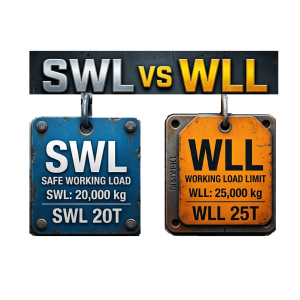
If you work with industrial machinery on a regular basis, you have probably come across the abbreviations SWL or WLL on chains, shackles, slings, hoists and hooks. Although everyone knows that these numbers represent the capacity of the equipment, not everybody knows what the abbreviation stands for and whether the two are identical.
Here is the point which needs to be
understood properly.
Safe Working Load (SWL) is the older of the two terms. The number marked on the equipment
stands for the maximum load capacity of a particular piece of machinery in
normal working conditions. This capacity is assessed by the manufacturer at the
time of production.
Working Load Limit (WLL), on the other hand, is the international standard term used
throughout the latest ISO and EN standards. Unlike SWL, this term is fixed and
corresponds to a certified safety factor. WLL cannot be re-interpreted in the
field; SWL used to provide more flexibility, resulting in misinterpretation.
Although the current legislation still mentions SWL, it is somewhat outdated with the word 'Safe' open to misinterpretation. It is very important not to confuse the two terms and understand why WLL became the standard.
Regardless of whether you read SWL or WLL,
the marked number stands for the maximum capacity of the equipment in the
conditions described by the manufacturer. In addition, the safety factor is
accounted for which implies that the equipment has to withstand a considerable
excess load before breaking.
This safety factor is supposed to cover all kinds of unexpected stress, the fact that no operation is perfect and all of the wear and tear. It is not the additional safety margin for the operator. Our experience shows that misinterpreting the marking in this way usually leads to mistakes.
And here comes the point which is most
frequently overlooked by operators. The number marked on your equipment was
obtained under certain conditions. Altering these conditions alters the real
safe load capacity.
The best example to illustrate this
statement is the marking of sling angles. Sling rated at 2 tonnes assumes that
the legs work close to vertical. Increasing the angle between them dramatically
increases the load acting on the leg; the sling capable of lifting 2 tonnes can
be incapable of lifting even half of it.
Other factors decreasing the safe load capacity include shock loading, uneven load distribution, corrosion and temperature. These aspects are seldom considered in practice.
It goes without saying that the entire
operation is as safe as its weakest element. Hoist, slings, shackles, hook –
each component has its own maximum capacity and the safe limit of the operation
depends on the component with the lowest capacity.
We have come across situations when a hoist capable of lifting a relatively heavy load was used with shackles capable of handling the load several times less. The common safety factor for each type of equipment provides for the explanation of such mismatching: lifting slings carry 5:1 safety factor, chain blocks and hoists 4:1 or 5:1, shackles 6:1. Check each component to match the WLL and safety factor as close as possible and adhere to the weakest component specifications, not only the main piece of equipment.
According to LOLER 1998, all equipment and
structures are required to be clearly marked with the SWL or WLL if it is
necessary to operate the equipment in a safe way. The rated capacity of the
equipment which depends on its configuration (multi-leg slings, adjustable
spreader beams) is required to be marked for all configurations possible, not
the most favourable one.
If you use the equipment in the configuration which is not marked on it, stop the process until the actual capacity is established.
SWL or WLL marked on your equipment
indicates its capacity in ideal conditions provided that it was in good state
at the moment of manufacture. The equipment damaged, worn out or corroded
reduces the capacity – and the marking does not change accordingly.
Our experience shows that the most dangerous piece of industrial equipment on any site is the damaged equipment which is still used. Frayed sling, bent hook or a shackle corroded should be removed immediately. The safe capacity of the damaged equipment is unknown – and its usage means risking something you cannot calculate.
Understand the difference between SWL and
WLL, know what the marking actually means and how it is influenced by
real-world conditions – this is what makes the safe operator different from the
one who thinks that the equipment will manage to handle the load.
Should you have any question concerning the
ratings or need help with choosing the right equipment, contact us. It is much
easier to get the equipment specification right in advance rather than face the
consequences of doing it incorrectly.
For help with all industrial equipment and
safe working loads, call us on 01384 76961.